
Six Sigma provides a data-driven methodology for reducing defects and improving process efficiency. The DMAIC framework allows organizations to systematically identify and eliminate operational inefficiencies.
Six Sigma should be implemented through a DMAIC framework focused on fulfillment defects and cost leakage. The Define stage defines that the performance of the fulfillment process is inefficient. The Measure stage involves monitoring late deliveries, wrong items, damaged items, avoidable returns, service escalations, and cost per order. The Analyze stage uncovers the root causes of the problem, including stock imbalances, demand variability, vendor quality issues, route constraints, and process variability. The Improve stage allocates action items. The Control stage tracks if the improvement is maintained.
The DMAIC structure should be considered as an improvement factory, not a quality definition. It should demonstrate how Amazon transitions from problem to measure, analyze, improve, and control. This framework is suitable for the assignment because it uses Six Sigma to address Amazon’s operational risk. The American Society for Quality defines Six Sigma as a process of variation and defect reduction through systematic process improvement (American Society for Quality, n.d.). For Amazon, variation reduction is a reduction in the rate of fulfillment errors that result in returned shipments, re-ships, customer service interactions, and lost customers.
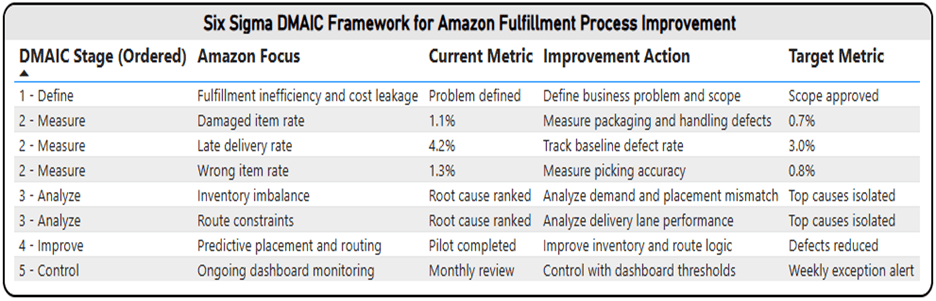
Figure 1: Six Sigma DMAIC Framework Applied to Amazon Fulfillment Process (Power BI)
Defects per million opportunities (DPMO) can be used as a metric in Six Sigma analysis. This enables Amazon to benchmark defect levels against targets in the areas of late delivery, wrong item, damaged item, and avoidable return. This allows quality improvement to be quantitative rather than qualitative. Six Sigma is effective because it links process defects to operating income: avoiding process failures reduces rework costs, maintains customer confidence, and enhances margins. The benefit of Six Sigma for Amazon is that it links customer experience defects to the protection of operating income. So, it is valuable for managers and executives alike.


Leave a comment