

Quality management is essential for maintaining operational efficiency at scale. Deming’s 14 Points provide a structured framework for improving processes and ensuring long-term organizational success.
Deming’s 14 points should be used as a quality system rather than a definition list. For Amazon, the primary purpose of adopting Deming’s points is to preserve operational discipline. This is important because service delivery is dependent on the integration of forecasting, fulfillment, marketplace management, delivery coordination, customer service, and financial planning. Operational problems in one area have cost and service implications across all parts of the customer journey.
Amazon should rely on consistency of purpose to deliver on time, fulfillment accuracy, marketplace confidence, and cost efficiency. Post-failure inspection should be replaced with quality control. This includes identifying inventory problems, supplier shortages, delivery problems, and demand spikes in returns before service defects reach customers. Deming’s management principles also promote multidisciplinary coordination because Amazon’s shipping issue is not the sole responsibility of one department. It may include forecasting, site planning, vendor quality, routing, customer service, and finance.
A model for implementing Deming should demonstrate how quality improvement progresses from data collection, cause analysis, process improvement, people empowerment, and management review. The associated KPIs should be on-time delivery, order fill cost, returns, forecast accuracy, and customer service. The W Edward Deming Institute stresses that the 14 points aim to change management practices rather than add quality inspection (The W. Edwards Deming Institute, n.d.). This is critical for Amazon, where the risk is system-level inefficiency. Deming makes quality a management issue, and not an after-the-fact inspection. His points can be turned into actions that are allocated, measured, and tracked.
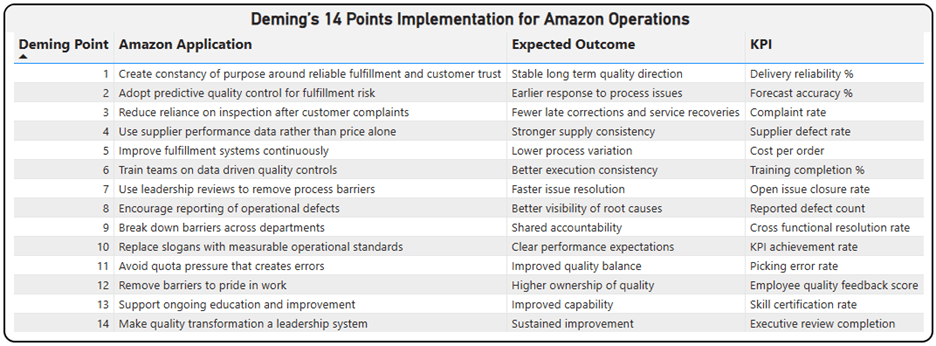
Figure 1: Implementation of Deming’s 14 Points Applied to Amazon Operations (Power BI)


Leave a comment