
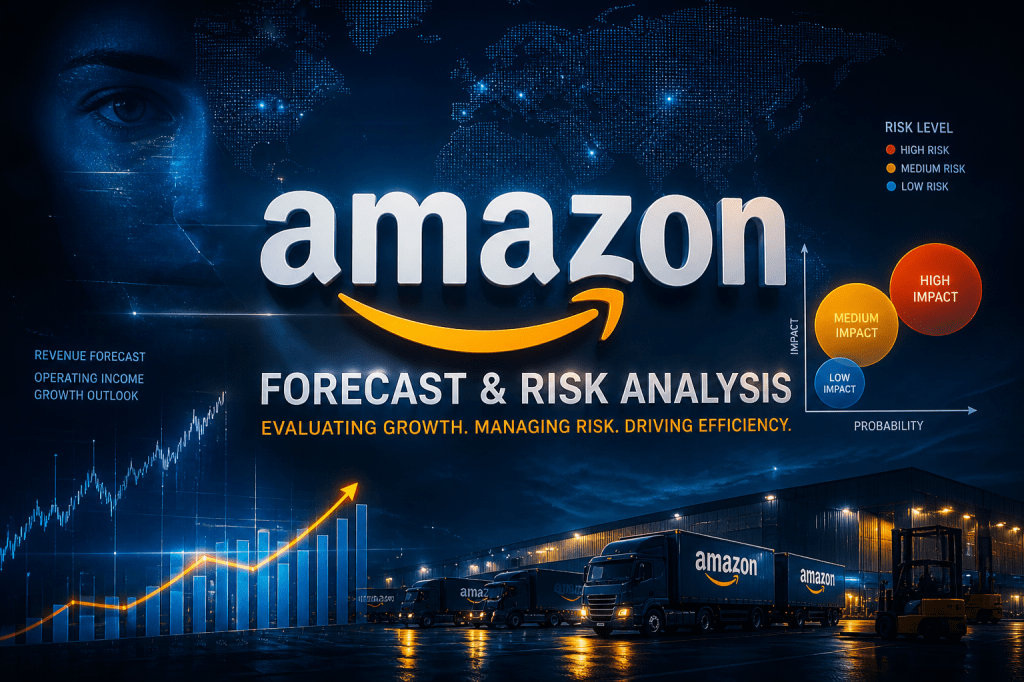
The key business intelligence issue facing Amazon is not a lack of market or product relevance. Rather, it is the growing complexity of its operations. Amazon’s growth in its network, marketplace, and service delivery creates the risk of moving from growth to control. This is similar to the case of Piaggio, where a successful and well-known organization suffered a downturn due to poor cost, quality, and responsiveness. In Amazon’s case, this could occur if issues of logistics, delivery on time, and service quality issues are not managed through formal quantitative analysis.
The Forecast Analysis shows that growth is not a good measure for long-term success. It is possible that a firm can grow while its operating margin efficiency deteriorates. This is important because it shifts the focus from growth to quality in growth. The model shows that stressed operations can destroy operating incomes even as demand is strong. This transforms forecasting from a projection approach to a strategy tool. It helps to anticipate operational stress ahead of financial eroding.
The Risk Avoidance analysis takes this a step further by translating risk into action. Using the formula Risk Score = Probability × Impact, the analysis provides a framework for decision-making instead of guesswork. This enables management to determine which risks require immediate action and which risks can be tracked. The focus on predictive control is a move away from problem-solving and towards prevention. This is crucial for Amazon as problems of scale can quickly grow if not dealt with early.
Deming’s 14 points support the management practices needed to drive improvement. It helps embed quality into the system rather than create a separate quality department. For Amazon, this requires integration between departments, better communication, and emphasis on long-term process improvement. Deming’s approach to quality treats it as a management responsibility and supports it through standard processes, goals, and assessment. This avoids the issues of silo mentality that can be common within large organizations.
Six Sigma adds a methodology for eliminating variation and defects. The DMAIC process offers a systematic approach from problem to control. Its value is in linking operational and financial performance. Amazon can enhance customer satisfaction and efficiency by minimizing defects like late shipments, wrong orders, and returnable goods. This highlights the fact that quality improvement is not just a tactical goal but also a strategic one.
Together, these elements form an integrated business intelligence solution. The forecasting shows the possibility of failure, the risk analysis shows the priority to focus on, the Deming provides system-level discipline, and the Six Sigma provides the methodology. This is important because a focus on just one of these factors will not solve the problem. Amazon needs a systemic fix to a systemic problem.
The final recommendation is that Amazon should treat fulfillment efficiency as a core strategic priority. The company must treat operating costs as a variable that can be managed within a data-driven approach, rather than a cost of doing business. The integration of forecasting, risk analysis, quality control, and process improvement will allow Amazon to maintain its competitive advantage and long-term profitability. This maximizes growth, sustainability, and scalability, and links operations with strategy.


Leave a comment