
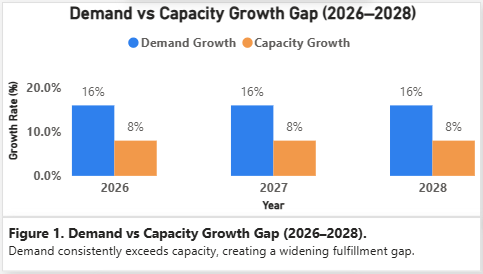
Amazon’s growth analysis indicates a significant imbalance between projected demand and existing capacity. The model projects a 16.0% annual demand growth compared to an 8.0% capacity growth rate, resulting in a widening fulfillment gap over time.
The analysis of expansion in Amazon justifies international expansion on the basis of fulfillment and logistical capacity as opposed to waiting and watchful approach. Excel model has a projected international demand growth rate of 16.0 percent against the current capacity growth of 8.0 percent per year. This creates a widening capacity gap from 0.16 in 2026 to 0.27 in 2027 and 0.40 in 2028. The model also implements a 2.8 billion average fulfillment center investment and a 68.0 percent rate of revenue that can be collected on unmet demand based on the recent scale and operating trend of Amazon as the starting point of the forecast (Amazon.com, Inc., 2025).
Under this scenario, unmet demand revenue rises from $112.3 billion in 2026 to $186.5 billion in 2027 and $281.4 billion in 2028. The recoverable revenue increases to $76.4 billion to $126.8 and finally to 191.4 billion in the same period. The model gives the same recommendation of expanding capacity on an annual basis since recoverable revenue is much higher than the investment cost in all three years. The growth of competitors is also projected at 10.0 percent and this justifies the necessity to act early instead of waiting until the market narrows down further (Amazon.com, Inc., 2024).
The lost opportunity is the key problem at the CEO level. When Amazon does not increase capacity and demand keeps accelerating, the company loses recoverable revenue, the speed of delivery, and customer satisfaction. $1 This capacity strategy also enhances the reliability of service in new markets since faster delivery performance reinforces the repeat purchasing behavior, brand trust, and the competitive edge of competitors that are investing in regional logistics coverage simultaneously.


Leave a Reply