

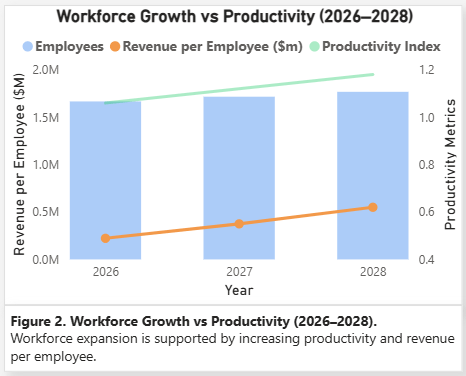
The personnel model of Amazon is directly connected with the projected expansion case. The Excel workbook is based on 16.0 percent demand growth, but it also thinks that with automation and improved labor leveling a 6.0 percent productivity improvement can be achieved. It implies that the workforce growth required is modelled at 10.0 percent as opposed to the entire growth of demand. The staffing model forecasts the workforce of 1,666,080 in 2026, 1,716,062 in 2027, and 1,767,544 in 2028, with the historical workforce based on the size and structure of workforce reported by Amazon (Amazon.com, Inc., 2025).
Revenue per employee improves from about $0.489 million in 2026 to $0.550 million in 2027 and $0.620 million in 2028. The productivity index is also enhanced to 1.06 and then 1.12 and further to 1.18. The model estimates the cost of hiring at approximately 1.15 billion in 2026, 0.90 in 2027, and 0.93 in 2028, and the cost of layoff is zero in the scenario since the model does not endorse the strategy of lean-through-layoffs when the company is expanding. This understanding aligns with the operating model based on scale and efficiency orientation of Amazon (Amazon.com, Inc., 2024).
This implies that the blog should not be advocating massive layoffs. The Excel model aids selective hiring, leverage in automation, seasonal leveling, and robust workforce planning. $1 A disciplined hiring plan also assists the managerial control since Amazon can deploy labor to areas with the highest demand volatility, lessen overtime strain during high-demand seasons, and maintain a consistent operating base across new facilities without requiring excessive control by the supervisors.


Leave a Reply