
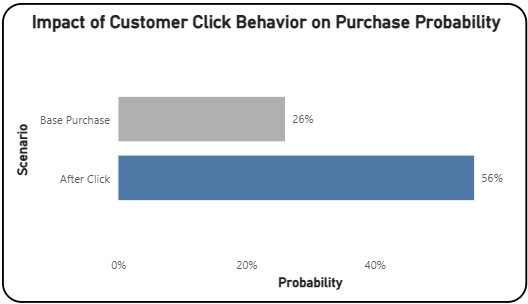
One of the most important findings in this analysis is how customer engagement affects purchasing behavior.
At a baseline level, the probability of a customer making a purchase is about 26%. However, when a customer clicks on a promotional banner, that probability increases to approximately 55.5%.
This shows that engagement more than doubles the likelihood of conversion. In simple terms, customers who interact with promotions are much more likely to complete a purchase.
This result reflects a Bayesian approach, where new information—such as a customer clicking—updates the probability of a purchase.
In addition, the customer journey shows a clear drop-off across stages. Out of 80 million customers exposed to a promotion, about 30 million engage, and roughly 21 million complete a purchase.
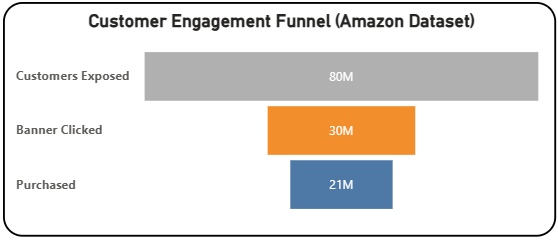
This drop-off highlights a key opportunity for Amazon. By improving engagement, the company can significantly increase conversion rates and overall performance.
The Bayesian Paradigm that Amazon should apply is a real-time marketing intelligence framework since customer behavior will truly change when new evidence signals are spotted. Based on the fictitious enterprise data, the probability of an exposed customer purchasing an item is 20,800,000 / 80,000,000 = 0.26, and the probability of a customer clicking on a promotional banner is 30,000,000 / 80,000,000 = 0.375. Assuming that the analysis of historical attribution indicates that 80 percent of buyers made a purchase after clicking, the posterior probability of purchase after clicking is 0.555:
P(Purchase∣Click)=0.80×0.26/0.375=0.555
Therefore, purchasing probability of a customer who clicks is 55.5% which is more than twice the original probability of purchase that is 26%. Further reasons to support Bayesian targeting include segment differences. Prime Loyalists buy at 38.0%, but Value Seekers only buy at 15.0%. Amazon is thus encouraged to redistribute media bids, home page offers, remarketing budgets to high-posterior clicking segments instead of spending an equal sum of money on all users.
The second application is one that deals with Prime membership acquisition. The previous likelihood of becoming a member of Prime is 7,100,000 / 80,000,000 = 8.88%, and the likelihood of achieving the benefits video with Prime is 28.0%. Assuming that 72 percent of new subscribers watched the video initially, then:
P(Prime∣Video)=0.72×0.0888/0.28=0.228
Thus, the probability of customers joining Prime after they finish the video is 22.8% which is almost three times higher than before. Tech Enthusiasts contribute 12.0% to Prime, Emerging Households 10.0% and Prime Loyalists 5.5%. Amazon ought to put into instantaneous one-click subscription when video viewing is done.
Cart abandonment recovery can also be done using Bayesian techniques. There is a 42.63% probability of creating a cart and a 73.31% probability of baseline checkout completion in a cart. Assuming 18,000,000 people were reminded who use the carts and 60% percent of the checkouts were made with reminder:
P(Checkout∣Reminder)=0.60×0.7331/0.528=0.833
This has a likelihood of an 83.3% checkout. Prime Loyalists turn carts 85.3% Tech Enthusiasts 76.1% Emerging Households 70.0% and Value Seekers 58.1%. Lastly, Amazon needs to develop a Bayesian Power BI Control Tower that will update the probabilities on an hourly basis. Given that 36.5% of all buyers are Prime Loyalists and 62.0% of Prime joins are done in collaboration with both Emerging Households and Tech Enthusiasts, various segments control different stages of the funnel. A continuous Bayesian update would be used to optimize spend, timing and offers automatically.


Leave a Reply